News
NAPICS Preview: The Presidents Panel
The 2006 North America Pizza & Ice Cream Show will feature a Presidents Panel including some of the most successful operators in the business. Siler Chapman, seen in the photo at right is one of them. But don't mistake the champion pizza tosser as a kid who's just playing around with dough. Read more to learn his secrets on running a great pizzeria.
February 15, 2006
 ChatGPT
 Grok
Grok Perplexity
 Claude
If it's true that success is 98 percent perspiration and 2 percent inspiration, one would hope his perspiration would be poured in positive production instead of wasted effort. Most successful business owners will say that missteps are mandatory on the path to success, but nearly all of them will say they wished they'd avoided a few of them.
On Feb. 19, during the opening day of this year's North America Pizza & Ice Cream Show, three leaders of three successful pizza companies will assemble for The Presidents Panel, and they'll share both the triumphs and trip-ups savored and suffered over their careers. To give readers a taste of what attendees of the show will hear, we asked each a several questions about what they've learned.
Mark Gold: co-founder, co-owner of Pizza Shuttle, Milwaukee. Gold has the distinction of running one of the nation's busiest pizzerias. In 2005, gross sales at the one unit-restaurant were nearly $5 million dollars, a feat rivaled by only two other pizzerias.
Arriving at that peak has not been easy, Gold said, but the 21-year-long ride has been a great adventure.
PizzaMarketplace: What do you think when people tell you they'd like to have a pizza business like yours?
Mark Gold: Well, I think they think it looks easy. Some think we just opened up and did $5 million a year. They don't see the work that went into it. Sometimes I get asked how old I am, and
|

PM: Would you call yourself a natural entrepreneur?
Gold: Maybe. I don't know that I'm a natural. I think people get mixed up over the difference between businessmen and entrepreneurs. I think an entrepreneur is someone who puts his own money at risk to get a reward. A businessmen runs companies without his own money. But when you're an entrepreneur, it's your (rear end) on the line, and if you lose, you have to file bankruptcy. That's a lot of pressure the businessman doesn't have. He moves on to another company.
PM: There will be some struggling business owners in the audience. What would you tell them to do that might motivate them to success?
Gold: Never give up, ever. I wanted to quit a million times, but I was too in debt to do it (big laugh). You've got to be persistent in doing the right things. You've got to have good timing, too, and if you're persistent and you do this long enough, you're bound to get the timing part right.
PM: Pizza Shuttle struggled early on to find its niche, so how did you stay focused when times were tough?
Gold: It really helped to have a partner. We would not have been as successful without each other. It also helped that we were young and didn't have any family obligations or mortgages to worry about. The guy starting out with a family and a house has a lot on his mind.
PM: Were someone to ask you how to start a pizzeria, what would you tell him?
Gold: I'm going to ask why you are getting into it. Are you in it just to make money? Because if that's all you want, you might as well get into a trade. That way, you'll make money the first day on the job. That doesn't happen when you start a business, especially a business like pizza, where a lot of drivers make more than the owner does early on.
If you just want something to do, then this isn't the business for you.
PM: Is a serious business plan really necessary?
Gold: I think a business plan is good because it will talk you into it or out of it. It will tell you what you think you can sell and what you can make. Everything you think about when you write your plan should be a worst-case scenario. Ask yourself, 'Could I take working 80 hours and making only $30,000 a year?' 'Can I afford health insurance?' I know it all sounds negative, but once you've answered these questions and you can say you still really want to do it, then give it a try. It comes down to this: You need to know why you're doing it before you get into it. Once you make a decision and stick to it, it's a lot easier.
Siler Chapman:founder and co-owner of Ice Cream and Pizza Works in Fort Mills, S.C. Siler Chapman has always known what he wanted. At 12, he signed a contract to race motocross and eventually became a
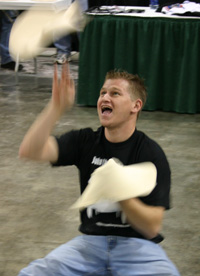 |
Siler Chapman is president and founder of Ice Cream and Pizza Works, as well as a memeber of the World Pizza Champions dough tossing team. |
PM: So you learned in a dream that God wanted you to open a pizzeria?
Chapman: I know it sounds crazy, but that's how it happened. I was 18 and was in my first year of college studying mechanical engineering at UNC Charlotte. Nine-eleven had just happened and jobs in that field were scarce. One night, I stood straight up out of bed and something spoke to me and said, 'You've got to open a pizzeria.' I'd been working in one, but I'd never thought about opening one. But I know it was the Lord telling me it was my calling. About 120 days later we opened. It went that fast.
PM: Where does an 18-year-old kid get the money to open a pizzeria?
Chapman: My grandparents once told me never to come to them and ask them for money unless it was a way for me to make money. I told them I wanted to open a pizzeria and that I had a 52-page business plan written up. They didn't believe I'd done it that quick, but I spent about a week researching the business and writing it up while I was in class.
PM: And while your parents were paying the tuition bill?
Chapman: Yeah. That's still not too heavily talked about (laugh).
PM: Surely people doubted you could do it.
Chapman: Yeah, they did. My mom kept telling me, 'You don't know what you're getting yourself into.' And I said, 'Oh, Mom, I'm good, I know what I'm doing.' And when I got in there, I was over my head. (His mother is now his business partner.) My grandfather wrote me a $180,000 check to get started, and he said, 'I know it's going to fail, but it's OK. I'm OK with pissing that kind of money away if you make an effort.' But I said to myself that I was going to prove him wrong.
PM: What would you tell someone who said they'd like to own a pizzeria?
Chapman: I'd stress that they understand what they're getting themselves into. Realize it's a lot of long hours and a headache — which is all OK because it's part of the challenge. But once you start, never look back.
PM: How have you stayed positive when business was tough?
Chapman: Mainly I never allow myself to get down. You should live every day as a new day and never look back.You can't.
PM: You've enjoyed quite a bit of success for one so young. How do you stay humble?
Chapman: You remember that no matter what, the customer can fire everyone in your business from the chairman on down. They're the ones writing your paycheck. You can't forget that.
Jack Butorac: President, Marco's Pizza Franchising, the franchise sales arm of Toledo, Ohio-based 145-unit Marco's Pizza. Butorac's restaurant industry career spans more than three decades and includes stops as an
 |
Jack Butorac, president, Marco's Franchising. |
PM: There will be many NAPICS attendees investigating whether the pizza business is right for them. Were you approached by one, what would you tell him about the business?
Butorac: I'd tell him to connect with a franchise company. The start-up process for an independent is extremely difficult. Communicating in a very competitive marketplace the message of how your brand is unique is tough for a single-store operator, and your chances of success are diminished significantly. Franchise concepts come with a system and a plan for running that business.
PM: You helped grow several small concepts into very large businesses. What's the key to accomplishing that?
Butorac: You've got to be able to relate to people. You've got to be able to motivate your employees without beating the heck out of them, but at the same time making sure they follow the standards. If yours is a pizza business, you've got to get involved in the local community. You've got to be a go-getter. If you want to sit back and relax in this business, you're not going to make it happen and you're just throwing money down the drain. You have to be aggressive.
PM: Much of your past experience was that of an executive. How do you relate to operators?
Butorac: The truth is I know it's a lot of work because I've been there, done that. I've been there at 8 a.m. to open and stayed there until I locked it up at 1 a.m. And those are the hours involved when you're starting a concept up.
PM: So how do you recommend people survive and thrive in such a business?
Butorac: It doesn't hurt to be young! Colonel Sanders started KFC at 65, but there aren't that many people who can do that at that age. It's demanding work, so you've got to love the business. There are people who like it, and people who don't. But if you love it, it's in your blood and you can't get away form it. I tried to, but I can't.
PM: You say you wish you had more time to spend with operators rather than staying inside the corporate office. Why do you miss that and how do you make the time to get out and about?
Butorac: There are certain things you have to do as a president, things you have to focus on, and they're not always things I like to do. But I've been busy putting the building blocks in place to help the company grow, and that takes a lot of my time right now.
That said, I like to go out and ride around to the stores and talk to operators and employees and see what works and doesn't work. Fixing problems is fun, I think. And the only way to go out there and do that is to go and talk to the operations people. You've got to be disciplined about making the time to do it. Otherwise, you lose touch.
PM: Getting into this business — much less succeeding in it — is tough. What are some smart things to do to prepare for a start-up?
Butorac: You've got to be well capitalized and you have to have a business plan that shows where your business is going. A lot of times single-store operators that aren't a part of a franchise system are not sophisticated enough to know to do that. You can get into trouble really fast that way, and that's why I prefer franchises.
Related Media
Subscribe
Get the latest news and resources from Pizza Marketplace.
Recent Posts