News
Parlor games
Pizza companies are increasingly relying on coin-operated games as an entertainment component for their businesses. Will this trend become one to watch?
September 16, 2004
 ChatGPT
 Grok
Grok Perplexity
 Claude
John Parlet merely wanted to entertain waiting patrons when he installed a Pong game in his pizzeria in 1973. But when the black-and-white video tennis game became a magnet for his customers' loose change, he knew he was on to something more.
He wasn't alone back then, as restaurants of all stripes started filling empty corners of lounges and waiting areas with video games. Not only did they take up less space than pinball machines, they were quieter, had fewer mechanical problems and they were equally addictive.
Thirty years later, Parlet has taken the game-and-pizza concept to the extreme with John's Incredible Pizza. The Lake Forest, Calif., company's five units average 55,000 square feet in size. They have carnival rides, more than 100 arcade and redemption games, as well as multiple dining rooms that serve an average 10,000 people per week. Start-up costs associated with one of these amusement parks under one roof is $7 million.
Yet despite the fun factor, Parlet said his business is pizza.
"First and foremost, this is a pizza restaurant that has a game component to it," said Parlet. "To give the customers the wow factor we want, it takes this much."
Parlet admits such an excessive set up isn't for everyone, and he believes it won't "ever be a mainstream thing like having pizzerias on every corner." But the fact that games and pizza go together, he added, can't be ignored.
Pizza-and-games concepts like Chuck E. Cheese's, Shakey's Pizza, CiCi's Pizza, Gattiland, among others, are drawing families seeking to eat and play together affordably. Operators say that when the whole family is involved, memories are made and return visits follow.
Independent pizza operators have proven they can get a slice of the fun (and the revenue), too, though on a smaller scale. Companies that own and service arcade-style games are plentiful and they're looking
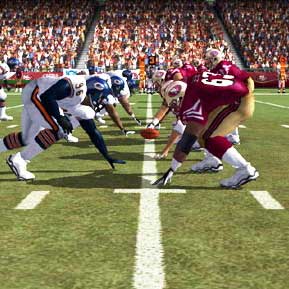 |
EA Sports' Madden NFL Football comes to coin-operated games this year. |
Old time fun
Human entertainment in U.S. pizzerias stretches back to at least the mid 1950s, when Sherwood "Shakey" Johnson launched Shakey's Pizza. Singers and musicians led upbeat sing-alongs that drew customers into a fun, family atmosphere.
About 20 years later, customer entertainment entered the brave new world of animatronics, when San Jose, Calif.'s, Pizza Time Theatre opened in 1977. At center stage was a robotic rat known as Chuck E. Cheese, who was backed by a broad cast of animal and human characters. The theater sold pizza and offered dozens of video games and pinball machines, which kept kids busy between stage shows.
When the company renamed itself Chuck E. Cheese's, the rat became a more approachable mouse, and it increased its family-and-fun focus by adding ball-pits and skytubes (a la Discovery Zone). Additional arcade-style games like Skeeball, and redemption games, were added as well. It appeared kids wanted to leave with more than a full stomach, and the range of prizes offered grew exponentially.
Today, no U.S. player can match 479-unit Chuck E. Cheese's mastery of the eatertainment sub-category of the pizza industry, but there are several similar concepts that are mixing pizza and play successfully. CiCi's Pizza, Eatza Pizza, Shakey's, Gattiland and Peter Piper Pizza are among the notable chains, while some independents within the eatertainment mix include 12-unit Stevi B's Pizza and Incredible Pizza Company in Springfield, Mo. Though the company is unrelated to John's Incredible Pizza, it does take the eatertainment theme to an equal extreme. The first of its two facilities covers 42,000 square feet and includes a go-kart track. Number two, which is under development in Tulsa, Okla., will open in a 96,000 square-foot former Kmart.
Most eatertainment companies cover the basics of pizza and games, but each company addresses both in varying amounts. Peter Piper and Chuck E. Cheese's serve pizza to order, while the others have extensive self-service buffets including pizza, salad, pasta and dessert. Where a Chuck E. Cheese's outlet may have 50 total games, CiCi's will have six to eight, none of which are redemption games. Phoenix-based Eatza Pizza strikes a middle ground between those concepts. CEO Ron Stilwell said the company's 28 stores used to average 4,000 square feet and have a game room with 15 or so options. But the company now is shopping for 6,000 square-foot units that can accommodate 180 seats and 25 to 30 games.
"Children's redemption games make our stores very profitable," said Stilwell. "A lot of times profit made on games alone pays for the rent."
According to Mike Magusiak, president of Dallas-based Chuck E. Cheese's Pizza, about one-third of the company's total revenue comes from its games; at the store level, games account for about half the total take. At CiCi's, in nearby Coppell, Texas, chief marketing officer Tom Koenigsberg said the six to eight games in each of its stores do make money, but not a significant amount. Yet to Randy Blair, owner of Pizza and Pipes in San Jose, Calif., the same number of games in his stores accounts for some decent pocket money: about $800 a month.
"It's nice, because that's some steady revenue," Blair said. "But really (games are) just something nice to have for the kids to do while the parents are eating."
Pay to play
Larry Cook, chief financial officer for Charlotte, N.C.-based games distributor Brady Distributing, said most pizza operators don't pay for their arcade games. Games operators (to whom distributors like Brady sell) convince those operators to make room for their games and then split the revenues equally. Plus, the game operator maintains and repairs the equipment.
Though John's Incredible owns all its games and has a paid staff to maintain them, Parlet said pizza operators who are interested in adding games should take the advice of game operators when it comes to assessing their needs.
"They can size up the operation and say, 'You need one of these, two of these, and so forth,' so that you have a good overall package of cranes, or video games or Skeeballs," said Parlet. His caveat to all operators however, is "The simpler, the better."
Eatza Pizza's Stilwell agreed that adding games isn't something to do blindly. "It's a separate part of our businesses that I
-- Ron Stilwell, |
 What this does is allow families to come in and have more than an eating experience. They get to have an entertainment experience, too."
Like John's Incredible, Magusiak said Chuck E. Cheese's views its games as assets requiring hands-on TLC. "So we have a tech in every one of our stores. We believe in maintaining them in the very best possible working order."
But even the best-running games aren't always the most popular, operators say. Games fall out of fashion with players, and that necessitates occasional rotations in the line-up. Cook said redemption games like Skeeball rarely rotate out, but video games — which compete with home games like Xbox and Sony Playstation — may stay in place only a matter of months.
And yet, the beauty of most computer-based video games is the ability to upgrade their software and add new games easily. Hardware changes to such games are minor, said Wes Harris, director of product marketing at games maker Global VR in San Jose.
"The idea is to use the (game's) cabinet as a platform for more than one game," he said. "Over time we release software updates that refresh the game for that cabinet. On our Need for Speed GT game, for example, a software upgrade will have different cars and tracks. ... Sometimes the graphics on the cabinet will change, or the marquees at the top of the cabinet will change to give a new look."
This year Global VR is introducing EA Sports' Madden NFL Football for coin-operated play. The smash hit home video game promises to engage older patrons, Harris said, because it's set up for tournament play. That should draw repeat crowds to pizzerias that have the units.
New growth or diversification?
When asked if eatertainment is a trend to watch in the pizza biz, no one interviewed gave a resounding yes. Brady Distributing's Cook said the number of large family entertainment centers is growing, but not impressively, and a bare few chains are adding a game component to their systems. By and large, he said, restaurant companies are focusing on their core business: foodservice.
Parlet admits that the cost of eatertainment centers like his is prohibitive, and that the sheer logistics of running such an operation would scare most folks away.
"It's a lot to manage, and I doubt too many want to do it, but it's what we do well," said Parlet, who will open his sixth store later this year.
According to a regulatory filing, Chuck E. Cheese's will open about 35 stores this year, Eatza Pizza wants to add about 10 units, and CiCi's is aiming for about 50. Considering that group makes up some of the largest of the pizza companies with a game component, such growth doesn't exactly amount to an explosion.
But as Stilwell points out, that expansion demonstrates that families respond to multiple offerings, both in food and fun.
"What this does is allow families to come in and have more than an eating experience," he said. "They get to have an entertainment experience, too."
Related Media
Subscribe
Get the latest news and resources from Pizza Marketplace.
Recent Posts