News
New York Pizza Show roundup: Show-stopping seminars
Pizza purism, passion and publicity dominated discussions during several seminars at the New York Pizza Show.
November 18, 2005
 ChatGPT
 Grok
Grok Perplexity
 Claude
NEW YORK — The seminar was titled, "Pizza Trends: Looking into the Crystal Ball," but leaders Ed Levine and Peter Reinhart did little in the way of prognostication during their hour-long session during the New York Pizza Show. As has been their wont since each penned a book about pizza in the last two years, discussion of the growing artisan movement in pizza industry dominated the discourse.
The agenda revision was a good one for a tradeshow held in America's pizza capital, where purists still ply their trade using simple recipes and ancient ovens. Pizza shops just like those in Manhattan are popping up all over America, said Reinhart, author of "American Pie: My Search for the Perfect Pizza," and that's a trend worth watching.
"What happened in artisan bread happened with beer, farm cheeses and chocolates, and that same grassroots movement is happening in pizza," said Reinhart, an instructor at Johnson & Wales University in Charlotte, N.C. He said pizza makers like Chris Bianco (Pizzeria Bianco), Anthony Mangieri (Una Pizza Napoletana) and Brian Spangler (Shoals Apizz) are purists devoted to truly handcrafted pizza, and their passion for perfection drives each to make every pizza served in their shops. "Chris Bianco told me, 'People ask me for my tricks, for my
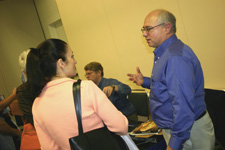 |
Peter Reinhart talks with an attendee of his seminar on pizza trends. |
Levine, who also wrote about Bianco in his book, "Pizza: A Slice of Heaven," said Bianco has rejected lucrative offers to franchise his pizzeria for one reason: He can't duplicate himself. When people understand and enjoy Bianco's pizzas, Levine said they enjoy Bianco the man. Without him tending the oven at his Phoenix restaurant, Pizzeria Bianco arguably ceases to exist.
"When you see him with his face streaked with flour and you watch him do his thing, it's amazing," said Levine. Mangieri, whose pizzeria is in Manhattan, is similarly pizza-centric. "I asked him once, 'Why don't you serve some salads? It'll improve your check average.' He said he didn't do that because he didn't want anything to get in the way of the pizza. He serves only two things: pizza and drinks."
George Schenk, founder of American Flatbread, an artisan pizzeria in Waitsfield, Vt., was in the audience and was invited by Reinhart to add to the discussion of passion. When an attendee asked how he could teach that same passion to his employees, Schenk said, "You have to work to fold that into the culture by talking about it with every employee, even all your customers."
Schenk made clear, however, that being passionate about food won't make him a starving artist. When his product is the best it can be, he believes charging a little higher-than-normal price is fair, and his customers will pay it.
"We need our margins, too, so we have to ask, 'What price would we have to charge if we used organic food?" said Schenk, adding that most all of his items use organic ingredients. "Every time we made the step up (to higher-quality products), the business responded accordingly. People understood."
That's because customers are actively seeking such kinds of dining experiences, said Levine. Those in the hunt for the best will pay a premium for food and drink deemed worth the expense. "Some will pay $6 for a beer, while others will pay only a $1. ... And when people go out to Una Pizzeria Napoletana or Pizzeria Bianco, they're not saying, 'Let's go out for pizza,' they're paying for an experience."
A heart of coal
John Brescio is a pizza purist of another type, an old-school master of coal-fired New York-style pies.
In 1994, Brescio resurrected Lombardi's Pizza, the nation's first pizzeria, which opened in 1905 before closing to the public 80 years later.
Longing for the pizzas of his youth and believing customers would scramble to buy them, the New York native recreated Lombardi's original dough and learned the nuances of baking in a coal oven. The task wasn't easy, and he's got the high blood pressure and four heart stents to prove it. But he insisted the whole adventure has been rewarding.
"We prospered from day one and it just kept growing from there," said Brescio. Part of the challenge in reopening the historic restaurant was turning it back into a pizzeria from the upscale Italian restaurant it became in the 1950s. "I wanted the menu to have just pizza and a couple of appetizers, not even hero sandwiches."
The simple menu, he said, keeps the focus on pizza, which, when cooked next to a burning pile of coal, requires a pizzaiolo's full attention.
"Our oven is 11 feet deep and 13 feet wide, and we go through 1,000 pounds of stove-oven coal every day," said Brescio. The surface temperature of the coal is about 2,000 F, but the air and deck temperature is about 900 F. "It takes about three-and-a-half minutes to cook a pie. ... We cook about 300 to 400 every day."
As much as he's a man of tradition, Brescio said if his shop weren't Lombardi's, he'd use a modern, open-flame
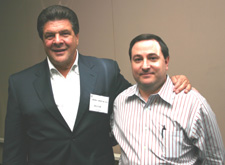 |
John Brescio, owner of Lombardi's Pizza, with son, Mike, who runs the business with him. |
"I'm the first pizzeria in America, so I have to have coal," he said. "If I had a gas oven, I'd not be Lombardi's. But believe me, I'd be shopping around for a new oven if I could. There is that much work involved with coal."
Brescio's opening remarks lasted only 7 minutes, which left the rest of the session for Q&A. Attendees asked questions about issues common to most pizza operators and Brescio entertained them all.
On delivery: "I've got six guys who deliver on bicycles only, and that's not easy in Manhattan." When asked how delivery riders cope with cold weather, his smiling face turned serious: "I've got Mexicans and Ecuadorians working for me, who aren't even used to the cold weather, and they get the job done.
"I've got nothing against American people, but American people don't want to work that hard anymore."
On portion control: "We charge $15.50 for an 18-inch pie. ... And I'm not cheap (on the toppings). But the guys were putting too much on ... and that starts the pie steaming, which means the dough gets floppy. We don't have time to weigh things out, so we worked for three or four months to watch what they were doing, and we got it fixed."
On working with his spouse: "I have a good wife, but when we got busy, we got on each other's nerves. So when we had enough money, she went home, and now she keeps the books."
On renting real estate in Manhattan: "A hundred bucks a (square-foot) is cheap here. ... And if you wind up doing good, (the landlord) looks to hang you after five years (when the lease ends.)" Asked what an operator in that situation should do, he said, grinning, "Cry as good as you can."
On why he never opened a delivery-carryout Lombardi's: "Because I like to mingle with people. I like to talk to everybody."
On quality: "If you use good product and make the right dough, you're going to have a good pizza. You don't have to be a college graduate to know taste."
Free publicity pays
In the small town of Punxsutawney, Pa., (pop. 10,000) Scott Anthony has done a remarkable job of getting the attention of the press and customers — for free. A single-unit franchisee of Fox's Pizza Den, Anthony shared how he makes friends with editors of the local paper and partners with other businesses to serve the community.
The common thread running through his remarks was the need for timeliness of notices to media outlets. Make sure a press release arrives well in advance of the event you want publicized. If the news outlet doesn't respond with requests for more information, send the powers that be a friendly reminder in the form of a free pizza or an invitation to your pizzeria.
"Understand that editors are always busy, so be respectful of their time," Anthony said.
How? By making their job as easy as possible, he said, and that begins with good press releases. To determine whether yours is useful to a news outlet, Anthony recommended asking the following questions:
- Is this an advertisement or a genuine piece of news?
- What kind of importance does this hold for the community?
- Is the story idea novel enough to excite readers?
- Does what you're trying to say directly affect your customer base?
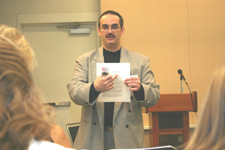 |
Scott Anthony discussed how to write good press releases during his seminar on getting free publicity. |
"When editors get a news release, they always ask the question, 'Who cares?'" he said. "Ask those questions with that in mind."
Anthony also advised attendees to conduct fundraisers that create goodwill and positive public perception of your business. One of his most successful events has been the Pizza & Prevention fundraiser, an annual event created after 9/11 to benefit local firefighters.
Fox's donates a full day's pizza sales, firemen deliver pies on their trucks, and while at customers' homes, they check for working smoke detectors.
The publicity Fox's received this year was priceless: three front-page news articles before and after the event, and a radio station donated a 5-hour remote broadcast.
The local Wal-Mart helped by donating batteries for smoke detectors and a local bank donated money to defray advertising costs.
"We donated $12,000 in sales, but all it really cost us was food cost," he said. "And since the firemen delivered all the pizzas, I had almost no labor."
Related Media
Subscribe
Get the latest news and resources from Pizza Marketplace.
Recent Posts