Restaurant Catering Workshop
Jason's Deli, Omnirev leaders talk guest data, AI for driving repeat catering business
AI and guest data can drive retention and turn guest data into revenue. Learn how during a panel talk at the Restaurant Catering Workshop, taking place Oct. 6-7 in Arlington, Texas.
August 28, 2026 by Judy Mottl — Editor: RetailCustomerExperience.com & DigitalSignageToday.com, Connect Media
 ChatGPT
 Grok
Grok Perplexity
 Claude
Retention, or repeat business, is the end goal in the restaurant catering business. It's a hard goal to achieve given all the dynamics involved, from labor and marketing to customer relationship management.
But AI is proving to not only make the goal achievable but attain it faster and cheaper, without the previous need for a massive team effort.
In simple terms, AI and guest data can drive retention and turn guest data into revenue.
The topic is the focus of a panel talk at the upcoming Restaurant Catering Workshop, taking place Oct. 6-7 in Arlington, Texas.
The two-day event is where restaurant operators and catering experts meet to share practical strategies, proven tactics and actionable insights designed to help brands launch, grow or optimize a more profitable catering business.
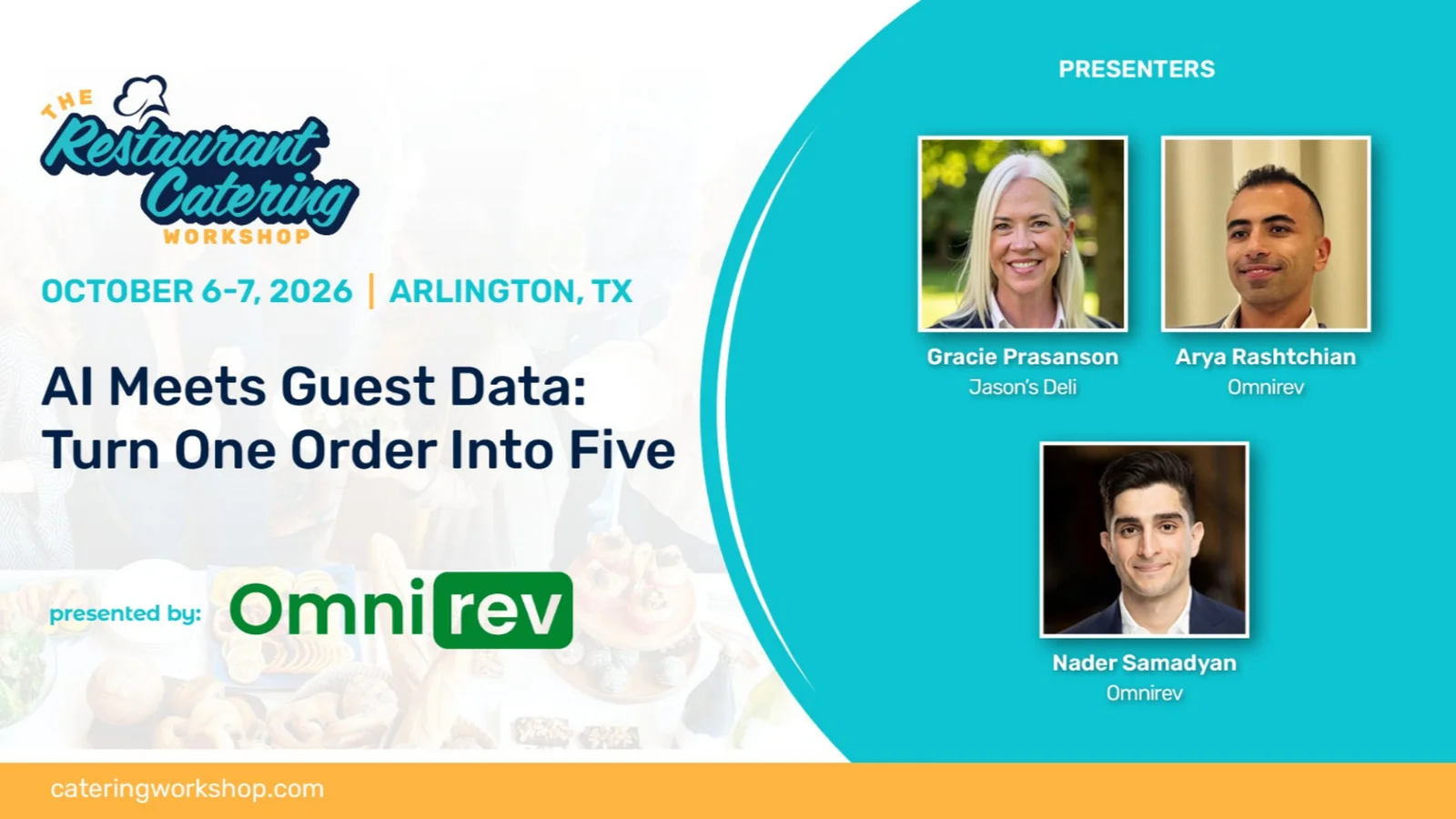
The session talk, "AI Meets Guest Data: Turn One Order Into Five," sponsored by Omnirev, features an expert panel: Gracie Prasanson, vice president of sales at Jason's Deli; Arya Rashtchian, co-founder and CEO of Omnirev and Nader Samadyan, co- founder, COO and head of product at Omnirev.
Why AI is so valuable
AI is a great tool when it comes to driving catering growth, according to Prasanson, as AI allows operators to do more with less in many ways.
"We can reach more customers, complete follow up steps in the sales process and assign important account outreach as needed. This takes many hours of research and planning from a staff member that many restaurants do not have to give," Prasanson said in an email interview. "In the restaurant these types of tasks are not prioritized and are left uncompleted, hindering your ability to grow your catering sales. This also frees up the sales team to spend more time cultivating new business."
Rashtchian views restaurant catering as "a relationship business sitting on top of a data problem," and AI is key to solving the problem.
Brands have years of order history and buried within are invaluable "signals" — signals that provide insight on which accounts are about to order again, which ones are quietly drifting away and which look like they could become large recurring customers, Rashtchian said in an email interview.
"No human team can read that at scale, across thousands of guests and dozens of locations. AI can."
AI, said Rashtchian, does not close catering deals as sales managers do.
"The pattern recognition tells your team exactly who to call and why; the relationship does the rest. That combination, the machine finding the signal and the human building the relationship, is what actually moves catering revenue."
Operators who treat AI as a replacement for the sales team tend to be disappointed.
"Operators who treat it as the thing that tells the sales team where to spend their day tend to see results fast. One brand we onboarded this summer with a mature catering program hit payback on the platform in five days," he said.
Where to start
A good first step in integrating AI into the business framework is to start with customer relationship management system, according to Prasanson .
This will let the business expand and grow the relationships with current accounts.
"There are many ways to expand your catering reach with the accounts and clients you are already serving. Look for ways AI can assist in order accuracy, order taking & driving new catering leads," she said. "AI is only as good as the data you feed it so make sure you are inputting the items that complete the background needed for success. Company/account details, contact details, order details and notes. With this information AI can look for the key details and serve up personalized quality outreach and tasks to grow your catering business."
Rashtchian mapped out three strategic moves catering operations should do first to integrate AI:
First: Clean up the data
Consolidate order history, contacts, and locations into one place, deduplicate, and make sure the fields that matter are populated: contact, location, order date, spend and occasion type. AI is only as good as the records it reads, and this is the single highest-leverage thing an operator can do.
AI is also the fastest way to do that cleanup. AI can merge duplicate accounts that a human would never catch, where the same office ordered under three slightly different company names and two contacts. It can normalize inconsistent addresses and phone formats, infer missing fields like occasion type or account category from the order itself, separate one-time consumer orders from real B2B accounts, and flag records that look wrong rather than silently trusting them. What used to require a data analyst and a quarter of calendar time now takes days. So the honest answer to "our data is a mess, we are not ready for AI" is that messy data is one of the first problems AI should be pointed at.
Second: Pick a tool built for the job rather than a general-purpose one
The test is whether it can act on the data, not just report on it. Dashboards tell you what happened. What you want is something that cleans the record, surfaces the account, and drafts the outreach.
Third: Onboard the team
Adoption is the real hurdle, not the technology. Sales managers need to understand the system is surfacing opportunities for them, not replacing them. If the team does not trust the list, they will not work the list, and nothing else you do matters.
What data is critical
When it comes to guest data every piece of guest data has value but Rashtchian said two applications pay off the fastest:
Lapse and churn detection: Every catering account has a natural ordering rhythm, and that rhythm is different for a school, a hospital, and a law firm. AI learns each account's individual cadence and flags when someone is falling off before they are gone entirely. Reactivating a lapsed account costs a fraction of sourcing a new one, and timing is everything. Reaching out at the right moment beats reaching out more often.
Next-order prediction paired with personalization: AI can estimate when an account is likely to order again and put a relevant message in front of them just ahead of that window, referencing what they actually ordered last time, for the right headcount, for the right kind of occasion. That level of specificity is the difference between a message that gets a reply and one that gets deleted. Guests can tell instantly when an operator knows them versus when they are on a blast list.
Best practices, do's and don'ts
Rashtchian said a good starting step is to point AI at the data quality problem before it's pointed at the guest.
"Deduplication, normalization and account classification are exactly the kind of work it is good at, and every downstream result depends on getting it right," he said.
He recommends keeping a human in the loop on any relationship.
"Measure outcomes, not activity. Reactivated accounts, repeat rate and average order value tell you something. Open rates do not," he said.
When it comes to the 'don'ts' he offered two tips. One is not to wait for the perfect data before starting.
"Perfect is not a prerequisite, and AI will get you to clean far faster than a manual cleanup ever would," he said.
The second tip is not to automate the relationship.
"AI opens the door; the sales manager walks through it. Don't send more just because you now can. Volume without relevance burns your list and your domain at the same time," he said.
The Restaurant Catering Workshop — Oct. 6-7, 2026 | Arlington, TX |
Upcoming Events
Restaurant Catering Workshop
October 6-7, 2026 | Arlington, TX
Discover the strategies and tools you need to build a winning catering operation. Whether you're starting out or refining your catering business, this workshop is your key to success.
View AgendaRegister NowAbout Judy Mottl

Judy Mottl is the editor of RetailCustomerExperience.com and DigitalSignageToday.com at Connect Media. She is an award-winning editor, reporter and blogger who has worked for top media for nearly four decades, including AOL, InformationWeek and Internet News, as well as for leading technology providers including HP. She’s written everything from breaking news to in-depth industry trends and reported on technology long before the internet arrived, including the debut of the first smartphone. When she's not sharing insights on digital signage deployments and trends in retail customer experience she's on the beach or watching the latest live murder trial.
Related Media
Subscribe
Get the latest news and resources from Pizza Marketplace.
Recent Posts


Recent Podcasts