Operations
Mellow Mushroom's 'fast fine' format slashes labor costs by 40% but keeps nostalgia
Mellow Mushroom is evolving its 50-year-old business model with a counter-service format that reduces labor and build-out costs for franchisees while preserving the brand's eclectic soul and signature food quality.
April 23, 2026 by Mandy Wolf Detwiler — Editor, Connect Media
 ChatGPT
 Grok
Grok Perplexity
 Claude
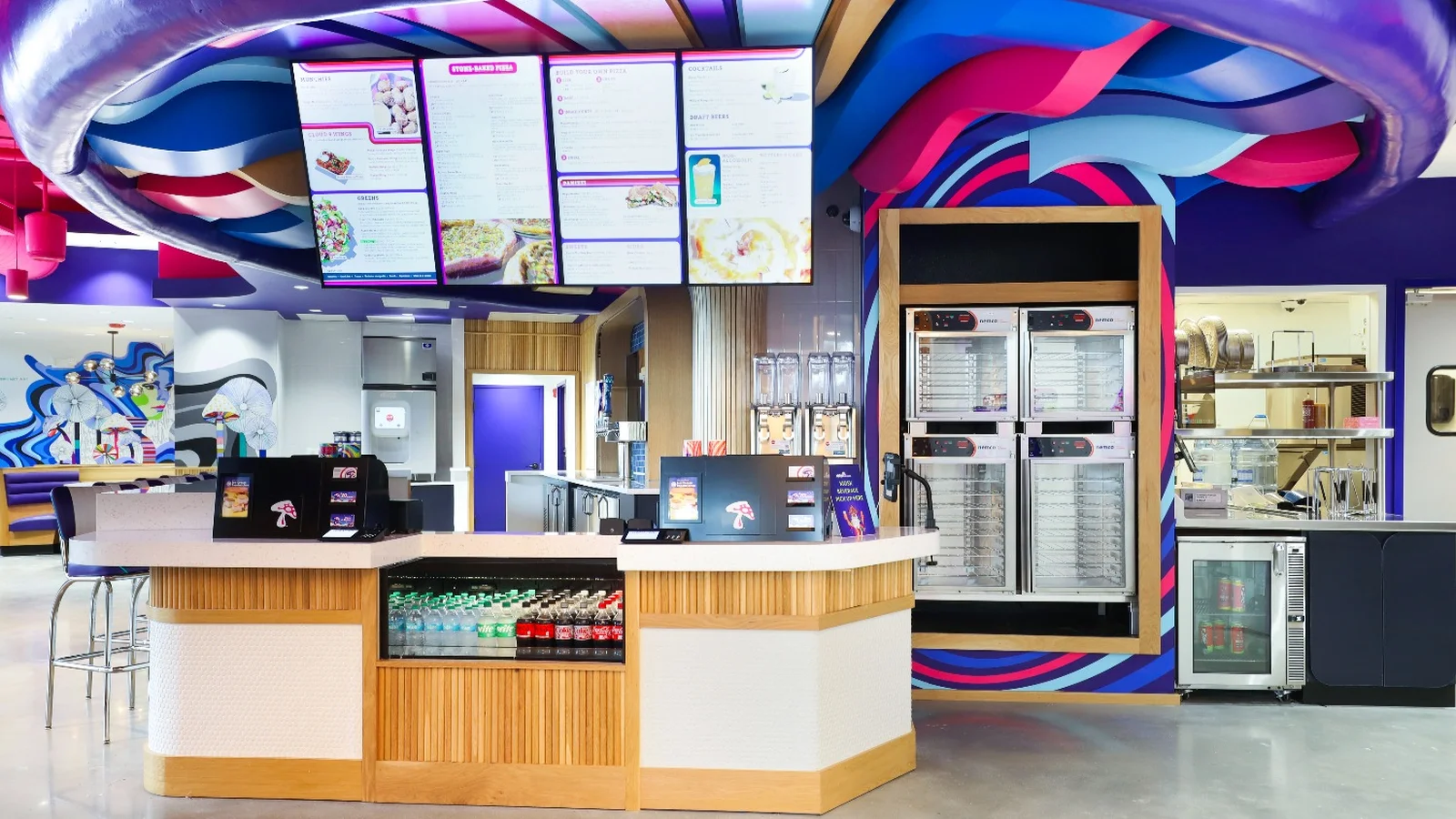
Mellow Mushroom, with 160 units, is evolving its 50-year-old business model with the launch of "fast fine," a counter-service format designed to streamline operations and lower the barrier to entry for franchisees. Developed in response to shifting consumer habits following COVID-19, the new model transitions away from the brand's traditional full-service approach to a "smaller box" design, targeting a footprint of 2,400 to 3,000 square feet.
This shift significantly reduces build-out costs and labor requirements, allowing locations to operate with a lean staff of 15 to 20 employees — a nearly 40% reduction in hours compared to full-service units. Despite the smaller scale, Executive Vice President of Strategy and Development Ahsan Jiva emphasizes that the model preserves the brand's "soul" by utilizing the same signature dough and employing "dining room liaisons" to maintain high standards of hospitality.
Mellow Mushroom started in 1974 in Atlanta. The brand's full-service locations have a "locals only" menu that is specific to each locale, and frequent Mellow Mushroom guests know they're in for a treat when they travel to different restaurants.
The company's founders didn't want to work for the man; they were happy doing their own thing, Jiva said.
"Fast-forward several years after Mellow got started. It was unapologetically celebrating amazing food, art, music and community. Mellow was really a product of its times because that's what the environment and the culture sort of reflected," Jiva explained.
Growth was slow and methodical, Jiva noted, because the founders didn't want to become a corporate chain. The word "chain" even became somewhat taboo in the organization, "and to some degree it still is." Jiva said. "We like to consider ourselves a collection of sorts, instead of a chain, because there's some connotations with the word 'chain' where you think, 'Okay, it's going to be the exact same footprint, look exactly the same, there's no uniqueness, no individuality,' and our founders really wanted to avoid that."
The brand grew with family and friends wanting to become franchisees. The founders didn't push the franchise agenda, choosing instead to keep Mellow Mushroom small and family oriented.
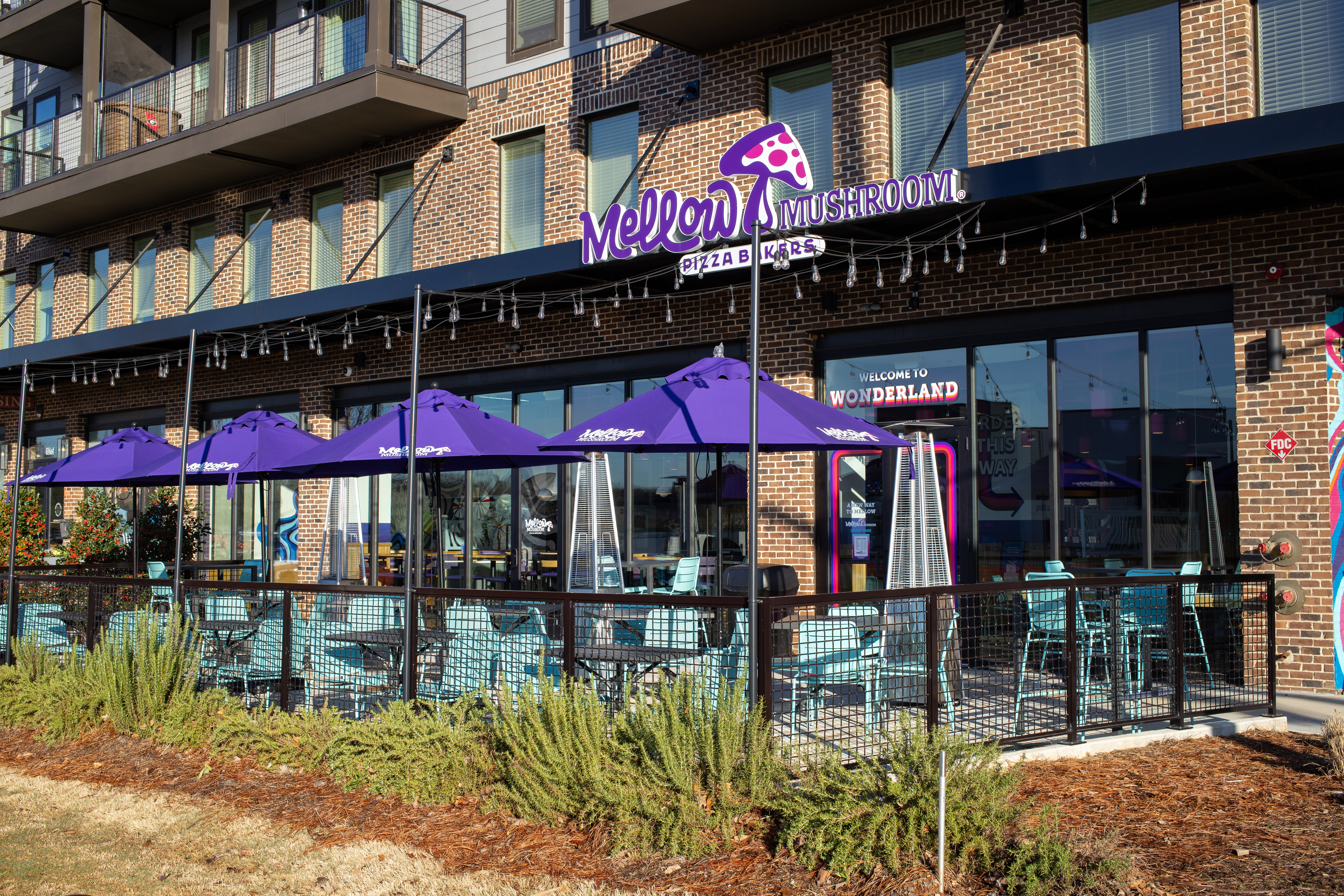 |
Photo: Mellow Mushroom |
Moving to 'fast fine' operations
And then the COVID-19 pandemic hit, changing the habits of the entire restaurant industry. Jiva said the brand did a deep dive of where they were with the business and took and look at what worked — and what didn't.
Potential franchisees and investors were coming to the brand wanting to franchise but either didn't have the capital or the will to run a full-service restaurant with servers, a bigger staff and a full bar.
The fast fine counter-service model was created two-and-a-half years ago. They didn't dub it "fast casual" because they weren't operating a Chipotle model where guests walk a line and create their own pizza.
The quality of the food and how it's prepared is still the bedrock of the brand, but the fast fine model is easier to run for franchisees. Jiva said it brought Mellow Mushroom back to its roots. They trimmed a bit of the menu down and introduced a handful of new items, like the Panizzi, a portable "mash-up" of pizza and panini.
The first fast-fine location opened in November 2024 in the Grant Park neighborhood of Atlanta. Mellow Mushroom is opening its second and third locations soon.
"The beauty about it is it's counter service, so it's less people to run," Jiva said. "It's got a slimmer menu, so from the operations side, it's a little bit easier from an execution and prep side, and it's a smaller box. We're targeting anywhere between 2,400 to 3,000 square feet, versus our full-service model, which is targeting anything around 4,000 plus."
That includes lower build-out costs. AUVs are slightly lower, Jiva said, without a full-service bar, but Mellow Mushroom still offers bottled and canned beer, wine and craft cocktails.
Jiva said the fast-fine model is good for infill opportunities in areas that have, say, three full-service restaurants in a particular market. If there's demand for more, fast fine is an opportunity for existing and new investors, filling in the market without over-saturating it or cannibalizing the area's full-service restaurants.
Once a guest has ordered, he or she gets a digital puck and sits down. A dining-room liaison brings the guest the order to the table and offers drink refills, "so it's not like you order at the counter and then you're kind of off on your own like in most other fast casuals. We still wanted to have that core tenet of hospitality within this model, too," Jiva added.
Kiosks have been deployed for ease of ordering, which has been well received by customers. The brand is seeing higher check averages with the kiosks.
With the fast-fine concept, employees are cross-trained on the menu because it is smaller than the full-service menu. The brand is also able to work with 15 to 20 employees instead of 20 to 40 with a full-service model. "From an hourly standpoint we typically see about a 35 to 40% reduction to run the restaurant," Jiva added. Because again, no servers, you don't have as many prep people or dish people. So, really, it's a lean staff that can still execute really well."
Jiva said he thinks about the fast fine focus through a Starbucks lens. He used to travel frequently for work, and he would visit different Starbucks cafes, roasteries and drive-thrus. Mellow Mushrooms are similar — they each have a certain feeling that is uniquely Mellow Mushroom.
"We don't see that as really an issue going forward because we see a lot of other brands also having different formats that fit different spaces and for different occasions. … The menu's still 85% the same, currently.
"That last 15% that we're kind of toying with and experimenting with over the next 12 to 18 months. I see those menus being 95% if not 100%, the same. We're going to eliminate any confusion there."
The brand's full-service locations have a "locals only" menu that is specific to each locale, and frequent Mellow Mushroom guests know they're in for a treat when they travel to a different restaurant.
Mellow Mushroom is known for its eclectic, psychedelic art and its atmosphere. How is the brand translating that sit-back-and-stay energy into a format designed for higher throughput?
"One thing from a brand standpoint is we didn't want to lose who we were and our soul and our DNA. So even our fast-fine restaurants do have at least one dedicated locally commissioned mural," Jiva said. "There's still a lot of artwork and a lot of fun things to tickle the senses, as I like to say, so a lot of sight, sound, hear, smell, touch. All those things we still want to keep as part of the brand."
About Mandy Wolf Detwiler

Mandy Wolf Detwiler is the Pizzamarketplace.com and QSRweb.com editor for Connect Media. An award-winning journalist, Mandy brings more than 20 years’ experience covering food, people and places. Mandy has been featured on the Food Network and has won numerous awards for her coverage of the restaurant industry. She has an insatiable appetite for learning, and, yes, she can tell you where to find the best pizza slices in the country.
Related Media
Featured Vendor

HungerRush brings every part of your restaurant together — orders, guests, data — in one platform built for fast casual and quick-serve multi-location brands ready to grow.
Subscribe
Get the latest news and resources from Pizza Marketplace.
Recent Posts
Recent Podcasts